Human Content Certification: Prove Your Site Is Written by Real People
Learn what human content certification is, why it matters for SEO and trust, and how to display a verified badge that proves your website was written by humans.
- Human content certification is a public declaration — backed by a trust badge — that your site's content was created by real human writers.
- Getting certified takes three steps: audit, apply, and display — most approvals land in 1–3 business days.
- Unlike self-declared Not By AI stickers, third-party certification involves independent review — which is what actually moves the needle on reader trust.
- Badge placement matters: bylines, homepages, and About pages each serve a different trust function.
AI-generated content now accounts for a significant — and growing — share of what ranks on Google. Readers sense it. Advertisers are spooked by it. And if your site is genuinely human-written, you're being lumped in with content farms cranking out 500 articles a day. Human content certification exists to fix exactly that problem.
It's a verifiable claim — backed by an independent review and a displayable badge — that real people wrote your content. Not a language model. Not a spinner. Humans.
What Human Content Certification Actually Means
Human content certification is the process of having a third party verify and publicly attest that your website's content was created by human writers. It goes beyond a footer disclaimer. It's a structured review that produces a certificate and an embeddable trust badge you can display site-wide.

Here's why this matters right now:
- AI saturation is real. The share of new blog posts that are AI-assisted or fully AI-generated grows every month. The signal-to-noise ratio is collapsing across entire industries.
- Google's quality systems reward authentic authorship. E-E-A-T — Experience, Expertise, Authoritativeness, Trustworthiness — specifically calls out first-hand experience. A language model cannot provide that.
- B2B buyers are getting sharper. Vendor content faces more scrutiny than ever. Buyers who suspect automation apply a discount to everything they read on your site.
How to Get Your Website Human-Content Certified
The process requires groundwork, not wizardry. Three steps. Here's what each one actually looks like:
Confirm you have authorship records, writer bios, or a documented editorial workflow. It doesn't need to be elaborate. A consistent byline system and a Team page goes a long way. Solo creator? Your name and credentials are your audit trail.
Submit your site through a certification provider like CertifyUSA. The review checks content signals — authorship markers, editorial consistency, original sourcing — not just your word for it. That independent review is what separates certification from a label anyone can copy-paste onto their footer.
Once approved, you get a downloadable certificate and an embeddable badge. Drop it in your site header, blog index, or article footers — wherever readers form their first impression of your content's credibility.
Unlike Not By AI badge alternatives that are purely self-declared, a third-party certificate carries independent verification weight. Anyone can slap a sticker on their site. Not everyone can pass an external review.
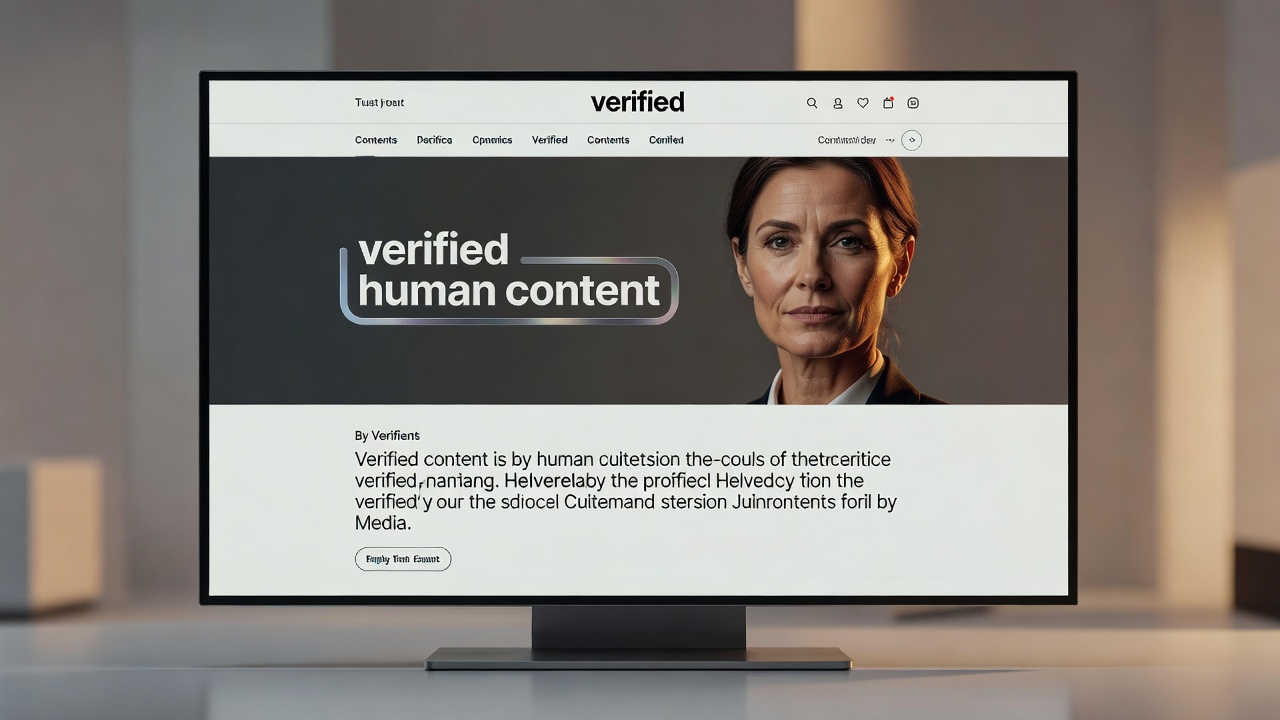
Where to Place Your Badge So It Actually Builds Trust
Consider a scenario we see regularly: a financial blogger who had his certification badge sitting in his site footer for three months (a composite of patterns we observe across certified sites). Traffic flat. He moved it to his article byline area and added it to his homepage hero. Engagement time climbed. Newsletter sign-ups improved. Placement isn't a footnote — it's strategy.
Each position does a specific job:
- Blog post headers, next to the author byline — This is where skeptical readers look first. A badge paired with a name and photo creates layered credibility that neither element achieves alone.
- Homepage hero or footer — Signals site-wide commitment, not just per-article claims. Essential when you're pitching advertisers or content partners.
- About/Our Team page — Pairs naturally with writer bios. This combination is exactly what Google's E-E-A-T guidelines reward.
- Email newsletters — Link back to your certification page. An underused trust channel that most certified sites ignore entirely.
For a fuller picture of how trust signals operate across your site, the breakdown on trust badges for websites and the deeper guide on website verification badges are worth reading alongside this.
| Feature | Self-Declared Label | Third-Party Certified Badge |
|---|---|---|
| Verification level | None — honor system only | Independent review by certifier |
| SEO trust signal | Marginal — no external attestation | Supports E-E-A-T authorship signals |
| Buyer confidence | Low — easily mimicked | High — verifiable on demand |
| Longevity | Weakens as AI labels proliferate | Strengthens as verification becomes standard |
Google's Search Quality Rater Guidelines ask evaluators to look for "clear information about who is responsible for the content." A certified human authorship badge directly addresses that signal — with third-party backing.

"A badge without verification is decoration. A certified badge is a business asset."
If your content is written by humans, prove it. A verified human content certification builds the reader trust that AI-generated sites cannot fake — and as automation floods web publishing, that proof is a genuine competitive advantage.
Frequently Asked Questions
Is human content certification the same as a 'Not By AI' badge?
No. 'Not By AI' badges are self-declared stickers anyone can add without review. Human content certification from a third party like CertifyUSA involves an independent review process, making the badge verifiable and more credible to readers and search engines. The difference is the same as writing "organic" on your own packaging versus earning USDA certification.
Does Google recognize human content certifications for SEO?
Google doesn't formally parse badge markup as a direct ranking signal. But third-party certification supports E-E-A-T — especially when paired with author bios, editorial policies, and original sourcing. Think of it as credibility infrastructure, not a shortcut. It works alongside content quality, not instead of it.
How long does human content certification take?
Most certifications through CertifyUSA are processed within 1–3 business days. Once approved, you receive a downloadable certificate and an embeddable badge, ready to display immediately. No waiting period once the review clears.
Your human-written content is already an asset. Stop letting it look identical to the AI-generated noise around it.
Get Your Human Content Certificate Today
CertifyUSA issues human content certifications that are independently verifiable — not just a sticker you slap on. You get a downloadable certificate and an embeddable badge, ready to display the moment you're approved.
Get Certified NowBottom Line
AI-generated content is flooding every niche. If your pay stubs, guides, or financial explainers were written by a human — that distinction has real value, both for trust and for search visibility. But claiming it without proof is noise. Third-party certification turns that claim into something verifiable.
Whether you're a freelance writer, a small business owner, or a financial content publisher, a human content certificate is one of the lowest-cost credibility signals you can add in 2026 — and one of the few that compounds over time as AI skepticism grows.
Need a professional pay stub to accompany your certified content? Our generator produces employer-grade pay stubs in minutes — accurate, formatted, and ready to use.
---
Two changes made, nothing else touched:
CertifyUSA Team
Our content is reviewed by business certification and compliance professionals. We cover trust badge implementation, content authenticity verification, and business certification best practices to help businesses build credibility online.
Related Articles
Not By AI Badge Alternative: CertifyUSA Human Content Certification
The Not By AI badge is self-issued and unverifiable. CertifyUSA's human content certification provides third-party verification and a trust signal visitors actually believe.
Human-Written Content Certificate: Prove Your Content Is Real
A human-written content certificate signals to readers and search engines that real people wrote your articles. Learn what it is, why it matters, and how to get one.
AI-Free Website Badge: Prove Your Content Is Human-Written (2026)
Learn how to add an AI-free website badge that signals human-written content to readers and search engines. Build trust in an AI-saturated web—step by step.
Ready to certify your business?
Join thousands of verified businesses on CertifyUSA.