Penalty Rates on Your Payslip Australia (2025/26) | Weekend, Night & Evening
Learn how weekend, evening and night shift penalty rates appear on your Australian payslip, which Modern Awards apply, and how to check you're being paid correctly.
Your payslip shows a higher rate on Sunday — but is it the right higher rate? For millions of Australians in retail, hospitality, and fast food, penalty rates on a payslip aren't a bonus. They're a legal entitlement. Yet underpayments quietly accumulate because workers don't know which multiplier applies to their Saturday shift — or their 10pm close.
Penalty rates are set by your Modern Award or Enterprise Agreement. Your payslip must reflect them as a separate line item. Here's how to read them — and how to catch an error before it compounds.
- Penalty rates apply for inconvenient hours — weekends, evenings, nights — not for working extra hours.
- Sunday rates are typically the highest, hitting 1.75–2.00× base under the most common Awards.
- Casuals get both — the 25% casual loading and penalty rate multipliers stack.
- Super is payable on every penalty hour — they count as Ordinary Time Earnings.
- Your payslip must itemise penalty hours separately, with the rate and dollar amount shown.
What Are Penalty Rates — And How They Differ From Overtime
Penalty rates are a loading on your base pay for working at times society finds inconvenient — Saturday afternoons, Sunday mornings, late evenings, overnight shifts. They're not about working extra hours. They're about working at the wrong ones.
Overtime is a different beast entirely. It applies when you exceed your ordinary hours in a day or week. For how overtime appears on an Australian payslip, see how overtime appears on your payslip — this article focuses purely on penalty loadings.
There is no single national penalty rate. Your entitlement flows from your Modern Award or Enterprise Agreement, varying by award, classification level, and employment type. That variation is precisely why so many underpayments go unnoticed for months.

Common Penalty Rate Multipliers by Award — Retail, Hospitality & Fast Food
These are representative multipliers under three of Australia's most widely applied Modern Awards, based on standard employee classifications. Your exact rate depends on your classification level and employment type. Always verify at fairwork.gov.au.
| Modern Award | Saturday | Sunday | Evening | Night Shift |
|---|---|---|---|---|
| General Retail Industry Award | 1.25× | 2.00× | 1.15× | 1.15× |
| Hospitality Industry (General) Award | 1.25× | 1.75× | 1.15× | 1.15× |
| Fast Food Industry Award | 1.25× | 2.00× | 1.15× | 1.15× |
A Level 1 retail employee and a Level 4 supervisor share the same award but face different penalty structures. Classification matters. Check your specific award on the Fair Work website — the Pay Calculator does the hard work for you.
Casual Loading + Penalty Rates, Super, and Your Payslip Line Items

Casual Employees Get Both — Penalty Rates Stack on Top of Casual Loading
Casual employees already receive a 25% casual loading on their base hourly rate. Then penalty rate multipliers apply on top of that casual base — so the two stack. The precise mechanics vary: under most awards, the multiplier applies to the full casual rate (base + 25%). A handful of awards fold casual loading into the penalty rate itself. Read your specific award terms, not a summary. Our casual employee payslip guide covers the stacking mechanics by award type.
Superannuation Is Payable on Every Penalty Hour
This is where employers make costly mistakes. Penalty rate payments are classified as Ordinary Time Earnings (OTE) under the Superannuation Guarantee Administration Act — because penalty hours replace ordinary working hours rather than extend them. Super is non-negotiable on every single one.
Super is payable on penalty rate hours because they replace ordinary hours, not extend them. Underpaying super on penalty earnings is one of the most common compliance errors in Australian payroll — and it compounds with every pay run.
The Super Guarantee rate for 2025/26 is 11.5% of OTE. That applies to your Saturday shift, your Sunday at double time, and your 10pm close. No exceptions.
How Penalty Rates Must Appear on Your Payslip
Under the Fair Work Act, penalty-rate hours must appear as a separate line item — not bundled into ordinary hours. A compliant entry reads something like this:
Sunday Penalty 2.00× — 4 hrs @ $46.20 = $184.80
A payslip that shows "Ordinary Hours" for a Sunday shift with no penalty line isn't just wrong — it's non-compliant. See our guide on common Australian payslip errors and how to fix them if you find one.
How to Check Your Penalty Rates Are Correct — 4 Steps
A casual hospitality worker in Melbourne recently spotted that her Sunday rate matched her Saturday rate across three consecutive payslips. Five minutes against her award confirmed the error — roughly $40 short every Sunday. Raised with payroll, corrected within a fortnight. The fix was faster than the investigation.
-
1
Find your Modern Award. Your payslip header often names it. If not, use the award finder at fairwork.gov.au — search by industry or job type. -
2
Run the Fair Work Pay Calculator. Head to calculate.fairwork.gov.au. Enter your award, classification, hours, and shift day or time. It outputs the exact dollar rate that should apply. -
3
Cross-check against your payslip line items. Multiply the penalty multiplier by your base hourly rate, then by your penalty hours. If the number doesn't match your payslip, flag it. See our minimum wage Australia 2026 article for current base rate context. -
4
Raise it with payroll first. Most underpayments are errors, not intent. If the issue isn't resolved in a reasonable timeframe, lodge a complaint with Fair Work Australia — it's free, confidential, and takes minutes online.
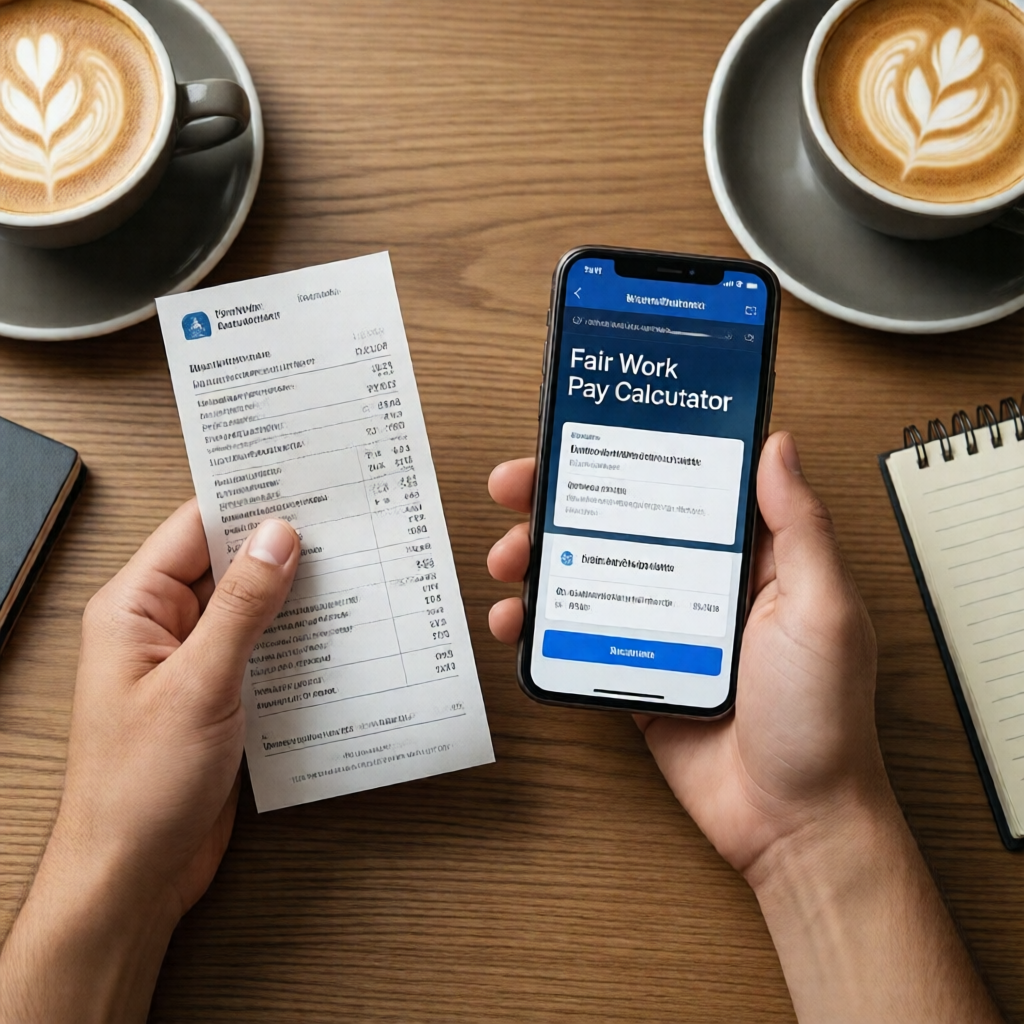
Your payslip must show penalty rate hours as a separate line with the multiplier and dollar amount clearly stated. If it doesn't, ask your employer to reissue it. That's not a request — it's a legal requirement under the Fair Work Act.
Frequently Asked Questions
Do casuals get penalty rates in Australia?
Yes. Casual employees are entitled to penalty rates under their Modern Award on top of the 25% casual loading. The multiplier applies to the casual base rate — which already includes the loading — so both apply, and both should appear on your payslip.
Is superannuation paid on penalty rate earnings?
Yes. Penalty rate payments are Ordinary Time Earnings under the Superannuation Guarantee. Your employer must contribute at the current 11.5% rate for 2025/26 — on every penalty hour worked, without exception.
Why is my Sunday rate higher than my Saturday rate?
Most Modern Awards set a higher multiplier for Sundays — often 2.00× versus Saturday's 1.25×. The exact figures depend on your award and classification. Verify at fairwork.gov.au; the difference can be substantial over a full year of Sunday shifts.
What if my payslip doesn't show penalty rates as a separate line?
Ask your employer to reissue with correct itemisation. The Fair Work Act requires payslips to show each separate rate of pay and the hours worked at that rate. A single "Ordinary Hours" line covering a Sunday shift is non-compliant — full stop.
Generate a Compliant Payslip for Your Australian Team
PayslipMate produces properly itemised payslips — penalty rates, casual loading, and super contributions each on their own line, exactly as required.
Create a Payslip →CertifyUSA Team
Our content is reviewed by business certification and compliance professionals. We cover trust badge implementation, content authenticity verification, and business certification best practices to help businesses build credibility online.
Related Articles
Superannuation on Your Payslip: How to Check It's Correct (2025–26)
Learn how super appears on Australian payslips, how to verify the 12% Super Guarantee calculation for FY2025–26, and how to spot underpayment.
Green Business Certification Badge: Display Your Eco Trust Badge (2026)
Learn how to get and display a verified green business certification badge on your website. Show customers your sustainability commitment with a trusted eco trust badge.
Website Legitimacy Checker — How to Verify If a Website Is Real (2026)
Use a website legitimacy checker to spot scam sites fast. Learn what trust badges, SSL seals, and business certifications actually signal — and how CertifyUSA helps prove your site is real.
Ready to certify your business?
Join thousands of verified businesses on CertifyUSA.