AI-Free Content Badge for Websites: Human-Written Verification Explained
Readers are demanding proof your content is human-written. Learn what an AI-free content badge is, why it matters for trust, and how to get certified for your website.
Readers are tired of clicking on search results only to find robotic, repetitive content that sounds like it was written by a committee of autocomplete suggestions. In 2026, that fatigue has turned into something more decisive: active distrust. And now, website owners who can prove their content is human-written have a real competitive edge. That proof is called an AI-free content badge — and demand for it is accelerating fast.
- An AI-free content badge is a verified trust seal confirming your content is written by humans, not AI.
- Reader demand for human-written verification is rising sharply as AI-generated content floods search results.
- The badge reinforces Google's E-E-A-T signals — real experience, real expertise, editorial accountability.
- Certification involves a review of your authorship process, then a badge embed you display site-wide.
- Advertisers and brand sponsors increasingly require human content certification before placing ads.
What an AI-Free Content Badge Actually Is
An AI-free content badge — sometimes called a human-written verification badge or human content trust seal — is a visible certification displayed on a website to signal one simple thing: real people wrote this. Not a language model, not a content spinner, not a prompt-and-publish pipeline.
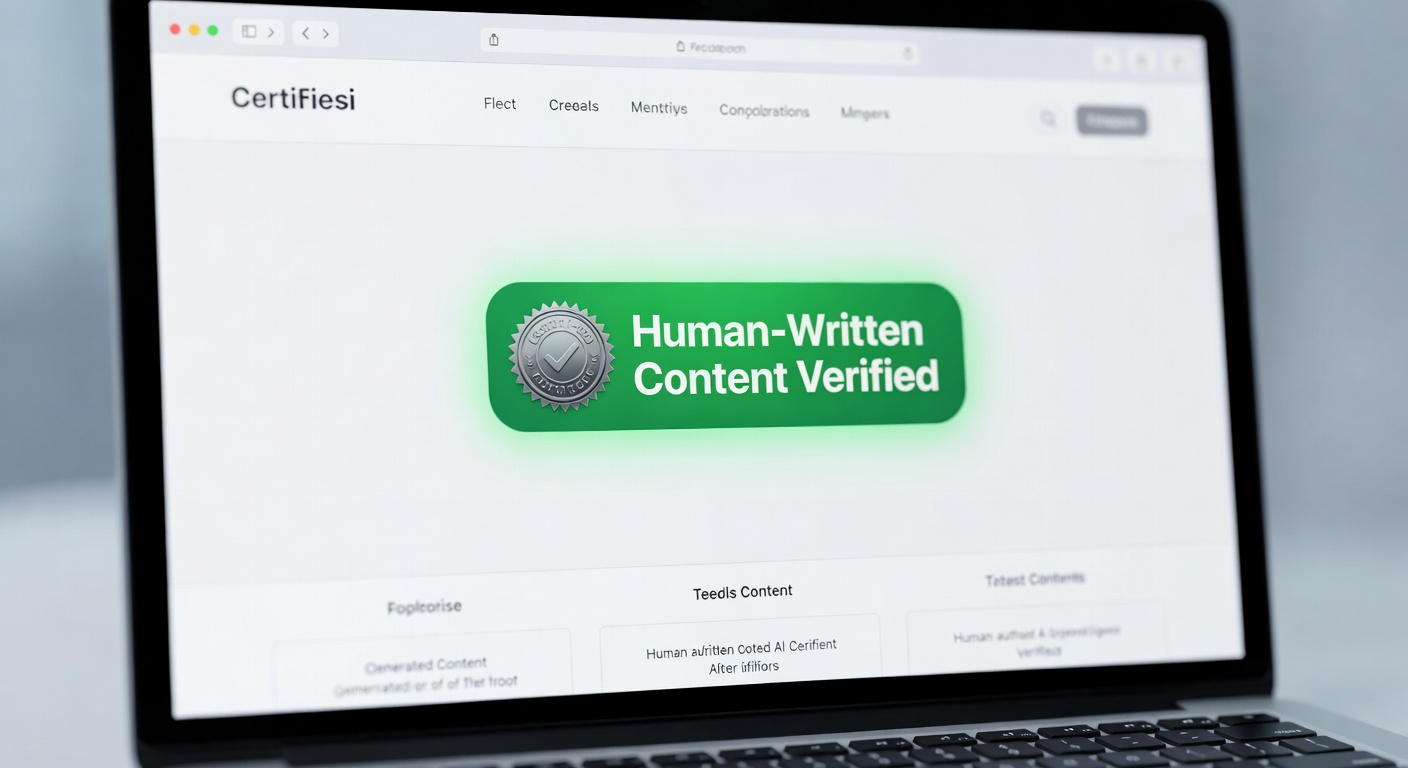
The surge of AI-generated content across the web in 2025–2026 created the problem these badges solve. When everything looks polished and nothing feels real, readers lose confidence — and they're increasingly making purchasing decisions based on who they can actually trust.
Why Readers — and Google — Are Demanding Proof
Here's the thing: your audience has developed a finely tuned radar for AI slop. They recognize the hollow lists, the hedging language, the uncanny absence of a real point of view. And when they detect it, they bounce. Fast.
That reader fatigue maps directly onto what Google rewards through its Helpful Content guidelines and E-E-A-T framework — Experience, Expertise, Authoritativeness, and Trustworthiness. A site demonstrating genuine human editorial process isn't just more trustworthy to people; it signals exactly what Google's quality raters are looking for.
"Authenticity isn't a nice-to-have anymore. It's the differentiator. Readers share content they trust — and trust requires knowing a human actually wrote it."
Sites displaying trust badges for websites that verify human authorship see stronger reader engagement and lower bounce rates — because trust converts. Skeptical visitors become buyers when you remove their biggest objection.
Some major advertisers and brand sponsors now require human-written content certification before agreeing to place ads on a site. For publishers monetizing through brand deals or display networks, the badge isn't optional — it's a revenue gate.
How to Get an AI-Free Content Badge for Your Website
-
1Submit your site and content samples for review. Provide URLs and authorship documentation — bylines, editorial policies, contributor bios. The more transparent your process, the faster the review.
-
2Verification checks authorship, editorial process, and AI-generation signals. Reviewers look at writing patterns, voice consistency, author credentials, and whether content shows genuine first-hand expertise rather than generic AI summarization.
-
3Receive your certified AI-free badge embed code. Once approved, you get a verified badge with a unique verification link — so readers can confirm your certification is real, not just a PNG you downloaded.
-
4Display it prominently — header, footer, or article bylines. Placement matters. A badge buried in the footer helps less than one near your content byline where trust questions arise most.
-
5Renew periodically to maintain certification status. Annual renewal keeps your badge credible — and signals to readers and sponsors that your commitment to human authorship is ongoing, not a one-time claim.
Take Marcus, a health content publisher in Denver. After 2025's AI content explosion made readers broadly suspicious of health sites, his newsletter open rates dropped and ad RPMs declined. After getting certified and adding the badge to every article byline, his average session duration climbed within 60 days — and two brand sponsors specifically cited the certification when agreeing to partnership terms.
Ready to prove your content is human-written?
Get Your Human Content Badge →The Bottom Line
AI-free content badges are becoming a genuine competitive differentiator — not a novelty. Businesses and creators who verify their human authorship now will build durable audience trust precisely as AI content continues flooding search results and eroding reader confidence. If you're serious about credibility, understanding what a website trust badge means and getting your own human content certification isn't a future consideration — it's a right-now advantage.
Frequently Asked Questions
What is an AI-free content badge and how does it work?
An AI-free content badge is a trust seal confirming a site's content is written by human authors, not generated by AI. A certifying body reviews the site's editorial process and authorship credentials, then issues a verified badge embed — with a verification link readers can click to confirm authenticity.
Does having an AI-free badge help with Google rankings?
Not directly as a ranking signal, but it reinforces the E-E-A-T signals Google genuinely values — real experience, human expertise, and editorial accountability. Sites with verified human authorship tend to align more naturally with Google's Helpful Content standards, which do affect rankings.
Who actually needs an AI-free content certification?
Any publisher whose audience cares about authenticity — health writers, legal bloggers, financial sites, news outlets, and e-commerce brands. If your content influences purchasing decisions or personal choices, your readers are already asking whether a person wrote it. The badge answers that question before they have to ask.
Can small content teams realistically get certified?
Yes — certification isn't limited to large media companies. Solo creators and small editorial teams qualify as long as they can document their authorship process: bylines, contributor bios, and an editorial policy explaining how content is produced and reviewed.
Stand out in a sea of AI-generated content.
Get your site verified and display a badge readers and advertisers can trust.
Start Your Certification at CertifyUSA →CertifyUSA Team
Our content is reviewed by business certification and compliance professionals. We cover trust badge implementation, content authenticity verification, and business certification best practices to help businesses build credibility online.
Related Articles
Artist Verification Badge for Website: Build Trust Online
Learn how an artist verification badge helps creators prove authenticity, build trust, and strengthen credibility on their website.
AI Free Content Badge for Website: Signal 100% Human Content
Add an AI-free content badge to your website in minutes. Learn why human content certification is becoming the new trust signal—and how to get yours free.
Not By AI Alternative: Certify Human Content & Display AI-Free Badges
Looking for a Not By AI alternative? CertifyUSA lets you certify human-written content, display verified AI-free badges, and build real reader trust — no third-party dependency required.
Ready to certify your business?
Join thousands of verified businesses on CertifyUSA.