Apostille vs Notarization 2026: Which Does Your Document Need?
Apostille vs notarization — learn the key difference in 60 seconds, when each is required in 2026, and how to avoid costly mistakes with international documents.
You have a document crossing a border — a marriage certificate, a diploma, an FBI background check — and someone told you to get it notarized. Then someone else said apostille. Same thing, right? Wrong. That confusion is the single most common reason international documents get rejected, and the delay it causes can kill a visa window, a job offer, an enrollment deadline.
- Notarization = domestic US use only. A licensed notary authenticates your signature for US courts, employers, and local agencies.
- Apostille = international use in any of the 120+ Hague Convention member countries.
- Apostilles often require notarization first — they're sequential steps, not alternatives.
- If your destination isn't a Hague member, you need embassy legalization — neither option alone works.
The One-Sentence Difference (And Why It Matters)
A notarization proves your identity and signature are genuine — for use within the United States. An apostille authenticates that notarization so it's legally recognized in foreign countries. One sentence. But every year, people submit notarized documents to foreign embassies and get them sent back. The cost isn't just the filing fee. It's weeks of delay. A missed visa. A job offer that expires.
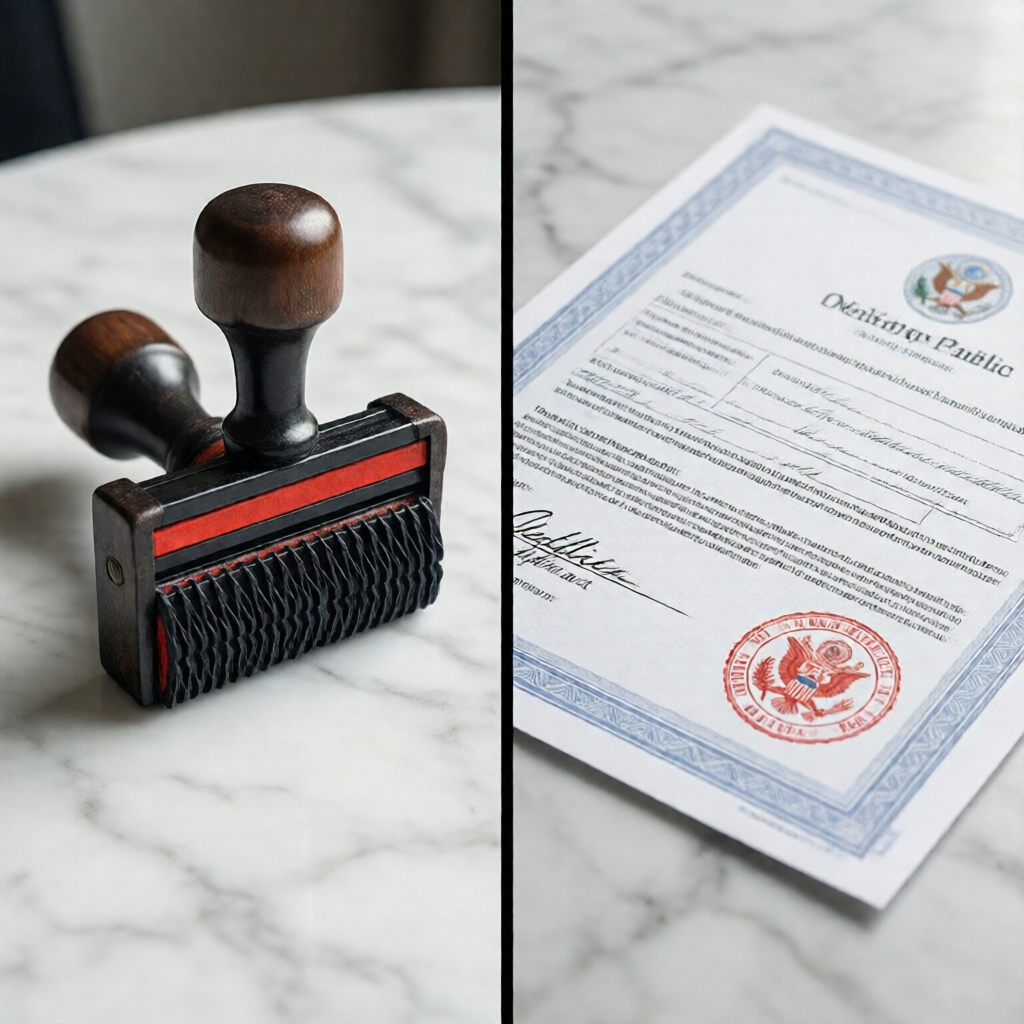
| Feature | Notarization | Apostille |
|---|---|---|
| Purpose | Authenticate signature for US use | Certify document for international use |
| Who Issues It | Licensed notary public | Secretary of State or US Dept of State |
| Where Accepted | United States only | 120+ Hague Convention countries |
| Typical Cost | $5–$25 per signature | $20–$150 per document |
When You Need Notarization vs. When You Need an Apostille
Skip the theory. Here are the actual use cases — the ones people call about every week.
- US employment forms and HR paperwork
- Domestic contracts and affidavits
- Power of attorney for US courts
- Local real estate transactions
- State-level legal filings
- Working or studying abroad
- International marriage or adoption
- Foreign business registration
- Foreign employment document verification
- FBI background check for overseas use
Over 120 countries accept apostilles under the 1961 Hague Convention — but if the destination country is not a member (Saudi Arabia, China, the UAE), you need embassy legalization instead. An apostille alone won't work. Neither will simple notarization. Check the difference between document authentication and apostille before you submit anything.
The 2026 Process: Steps, Costs, and Timelines
Notarization is fast. Apostille has more steps — and that's the part that catches people off guard.
Notarization (1–2 hours, anywhere in the US):
-
1
Find a licensed notary — UPS stores, banks, and Remote Online Notarization (RON) platforms all work.
-
2
Sign the document in their presence — or via live video for RON.
-
3
Pay the notary fee — typically $5–$25 per signature, depending on state.
Apostille (1–15 business days):
-
1
Get the document notarized first, if required — most personal documents need this step.
-
2
Submit to the issuing state's Secretary of State office — or the US Dept of State for federal documents like an FBI background check.
-
3
Pay the state fee — roughly $20–$150 depending on state and document type.
-
4
Wait. Standard processing runs 5–15 business days; expedited options cut that dramatically.
An apostille often requires notarization as a first step. They are not alternatives — they are sequential. Skip notarization when it's required and the Secretary of State's office will reject your apostille application outright. See the full step-by-step apostille checklist for 2026 before you submit.
Consider James, a software engineer from Austin — a composite of cases seen regularly — who had his diploma notarized and sent it straight to the Spanish consulate for a digital nomad visa. It came back rejected. The consulate needed an apostille from the Texas Secretary of State, not a notary stamp. Two extra weeks. One missed visa window.
Quick Decision: Which One Do You Actually Need?
Three Questions That Decide Everything:Q1: Is your document being used inside the US only?
→ Notarization is all you need.Q2: Is your destination country a Hague Convention member?
→ You need an apostille (likely after notarization).Q3: Is your destination country NOT a Hague member?
→ You need embassy legalization. Neither apostille nor notarization alone will satisfy foreign authorities there.
Most people heading to Western Europe, Latin America, or Australia fall into Q2. The apostille route is standard. Going to China, the UAE, or Qatar? Look up embassy legalization requirements before you do anything else. Also worth reading: the guide on credential evaluation vs. credential verification if your documents include foreign qualifications going the other direction.
For 2026 international use, an apostille is almost always required — notarization alone will not satisfy foreign authorities in Hague Convention countries. Not sure whether your destination is a member? Check before you pay a notary. The apostille document checklist covers exactly what you need by document type.
Frequently Asked Questions
Can a notarized document be used internationally?
No. A notarized document is valid for domestic US use only. For international acceptance in Hague Convention countries, you must obtain an apostille — typically attached after notarization. Submit a notarized-only document to a foreign authority and it will be rejected.
Do I need both an apostille and notarization?
Often yes, in that order. Many apostille applications require the underlying document to be notarized first. The apostille is then attached by the Secretary of State to authenticate the notary's signature for foreign use. Notarization is step one. The apostille is step two.
How long does it take to get an apostille in 2026?
Standard processing runs 5–15 business days through most state Secretary of State offices. Expedited services cut this to 24–72 hours for an additional fee — typically $50–$150 depending on the state and document volume.
What if I already have a notarized document — can I still get an apostille?
Yes, in most cases. A recently notarized document from a currently commissioned notary can typically receive an apostille directly. Very old notarizations, or notaries who are no longer commissioned, may require re-notarization first.
Getting authentication right on the first attempt saves weeks. Preparing for international employment, study, or official filings abroad? Start with the apostille requirements for foreign employment documents to make sure you're not missing a step specific to your use case.
Ready to apostille your document?
Use the complete 2026 checklist to make sure everything is in order before you submit.
View the Apostille Checklist →The Bottom Line
An apostille is not just a formality — it is the legal bridge between your U.S. documents and the foreign authorities that must accept them. The process has a clear sequence: notarize first, apostille second, translate if required. Skipping or reversing any step means starting over.
- Use the Hague Convention country list before assuming an apostille applies
- Match your document type to the correct issuing authority
- Request certified copies — never submit originals you cannot replace
- Budget 2–4 weeks for standard processing; 3–5 days if expediting
Need Employment Income Documents for Your Application?
Many apostille filings — work visas, residency applications, foreign employment contracts — require proof of income alongside the certified documents. A professionally formatted pay stub showing your earnings, employer details, and deductions gives foreign authorities the financial picture they need.
If you are self-employed, a contractor, or need to document income quickly for an international submission, a generated pay stub can serve as supporting income evidence alongside your apostilled employment records.
Generate a Professional Pay Stub in Minutes
Create accurate, formatted pay stubs for visa applications, foreign employment files, or income verification — no employer needed.
Create Your Pay Stub Now →CertifyUSA Team
Our content is reviewed by business certification and compliance professionals. We cover trust badge implementation, content authenticity verification, and business certification best practices to help businesses build credibility online.
Related Articles
Apostille vs Notarization: Which Do You Need in 2026?
Apostille vs notarization — confused? Learn the key difference in under 5 minutes and find out exactly which one your document requires in 2026.
Sustainability Certification Badge for Websites | Verified Green Business Seal
Learn how to display a sustainability certification badge on your website. Show customers you're a verified green business with an eco-friendly trust seal that builds credibility.
Superannuation on Your Payslip: How to Check It's Correct (2025–26)
Learn how super appears on Australian payslips, how to verify the 12% Super Guarantee calculation for FY2025–26, and how to spot underpayment.
Ready to certify your business?
Join thousands of verified businesses on CertifyUSA.