FISMA Compliance Badge for Website | Federal Contractor Trust Signal
Learn how to display a FISMA compliance badge on your website to signal federal security standards to government clients. Includes badge embed CTA and B2B guidance.
Your company just made the federal contractor shortlist. The procurement officer opens your vendor portal, scans for security credentials — and finds nothing. No badge. No signal. Just a clean homepage that could belong to anyone. That gap costs contracts. A FISMA compliance badge for your website closes it.
The Federal Information Security Modernization Act (FISMA) requires every federal agency — and every contractor or vendor that handles federal data — to meet a defined set of security controls. A FISMA compliance badge tells procurement teams and contracting officers your systems meet that statutory baseline before they open a single page of your proposal.
- FISMA badges tell federal procurement teams your systems meet the security baseline required to handle government data.
- FISMA is the statutory umbrella — FedRAMP, CMMC, and NIST 800-53 all sit beneath it.
- You can generate and embed a FISMA badge in three steps — no legal team required.
- Small businesses bidding on government contracts can and should display one.
What Is a FISMA Compliance Badge and Who Needs One?
Most IT vendors assume FISMA is an agency-only concern. It isn't. The law explicitly extends to any contractor, subcontractor, or third-party service provider whose systems process, store, or transmit federal information. If your SaaS platform touches a government agency's data — even indirectly — you're in scope.

FISMA compliance is built on the NIST SP 800-53 control framework: access control, incident response, configuration management, risk assessment, system integrity. The controls that apply to your environment depend on the impact level of the information you handle — Low, Moderate, or High. Most commercial vendors working in the federal space fall in the Low-to-Moderate range. That's a manageable baseline. It's not an excuse to skip the signal.
Consider David Park, an IT services contractor based in Northern Virginia (a composite of vendors we see frequently). His company had completed a full security assessment and obtained an Authorization to Operate (ATO) — but nowhere on his website did that signal appear. When a mid-sized federal agency ran a shortlist review, his firm was deprioritized because competitors had visible compliance indicators. The technical work was done. The trust signal wasn't there.
Procurement officers reviewing 40+ vendors don't have time to deep-read every security policy. A badge is the 3-second credibility check that keeps you in the running.
Displaying a FISMA compliance badge on your website makes your security posture visible — on the pages procurement teams actually visit.
FISMA vs. FedRAMP, CMMC, and NIST: How the Badges Differ
These frameworks are related but distinct. Mixing up their badges signals the wrong credential to the wrong audience. Here's the breakdown.
| Framework | Who It Applies To | What It Covers | Badge Use Case |
|---|---|---|---|
| FISMA | Federal agencies + all contractors handling federal data | Statutory security program, risk management, ATO process | General federal vendor credibility |
| FedRAMP | Cloud service providers selling to federal agencies | Cloud-specific authorization, continuous monitoring | Cloud SaaS/IaaS/PaaS vendors |
| CMMC | Defense contractors (DoD supply chain) | Controlled Unclassified Information (CUI) protection | Defense industrial base vendors |
| NIST 800-53 | Any org using NIST controls — voluntarily or by mandate | Technical control families: access, audit, config, incident response | Broadly applicable; underpins FISMA |
FISMA is the law. NIST 800-53 is the rulebook it uses. FedRAMP and CISA-aligned frameworks are specialized programs built on top of that statutory foundation. If you're a general IT contractor or SaaS vendor selling to civilian federal agencies, FISMA is your primary signal. Full stop.
How to Display a FISMA Compliance Badge on Your Website
Three steps. No legal team, no six-month engagement. Here's the practical path.
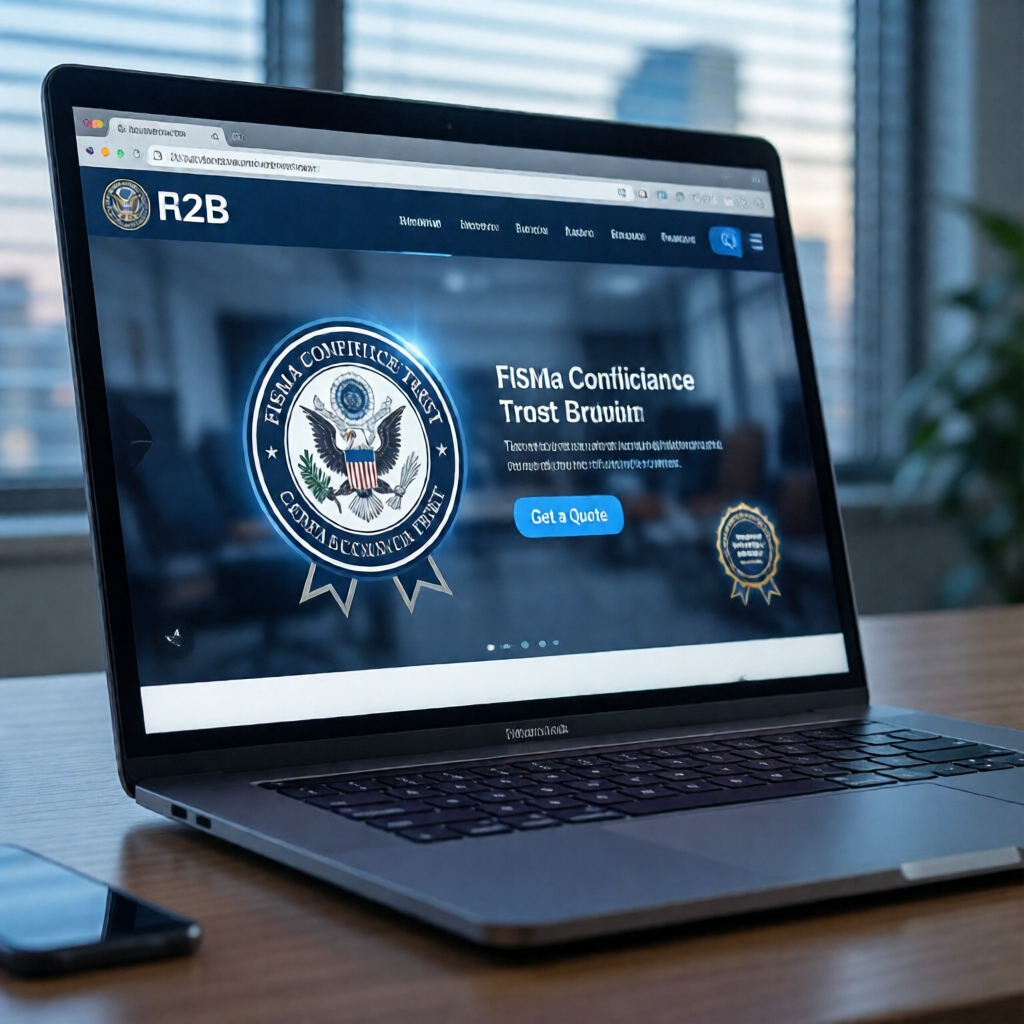
If your organization has completed a FISMA security assessment, you should have an ATO letter, a System Security Plan (SSP), or documented evidence of NIST 800-53 control implementation. This is your foundation. Without it, don't display the badge — the documentation has to exist first.
CertifyUSA's business certification platform creates a verifiable FISMA compliance badge tied to your business profile. The badge includes a unique verification link — when a procurement officer clicks it, they land on a live verification page, not a dead image file. That's the difference between a badge and a credential.
Don't bury it in a footer. Place it on your homepage hero or above-fold trust bar, your dedicated security/compliance page, and any vendor portal or capabilities statement PDF. Federal procurement teams often scan your site before reading your proposal — meet them where they look. Check your overall trust score to see how your compliance signals stack up against the full vendor credibility picture.
Many federal RFPs now ask vendors to include a compliance badge URL directly in the technical proposal. Having one pre-built through a verifiable platform eliminates the last-minute scramble before submission deadlines.

One critical distinction: displaying a badge doesn't replace your actual security documentation. It signals it. The business verification process behind the badge is what gives it weight with sophisticated procurement reviewers. A badge without a verifiable source is just a logo.
For federal contractors and government-adjacent businesses, a FISMA compliance badge shows procurement teams your security posture before they have to ask — keeping you on shortlists where every credential counts. CertifyUSA lets you generate and embed a verifiable badge in minutes. No legal team, no long engagement. Your security posture is already the asset. The badge is what makes it visible.
Frequently Asked Questions
Is a FISMA compliance badge the same as a FedRAMP authorization?
No. FedRAMP is a specific cloud-focused authorization program administered by the federal government. FISMA is the broader statutory law requiring all systems handling federal data to meet security standards. A FISMA badge signals general statutory compliance alignment; FedRAMP is a formal, government-managed certification exclusively for cloud service providers selling to agencies.
Can small businesses display a FISMA compliance badge?
Yes — and small businesses have more to gain from it than established primes. Any organization that handles federal data or bids on government contracts can display one. For smaller vendors without a household name, visible compliance signals carry outsized weight. That's exactly the point.
What security controls does FISMA require?
FISMA compliance is built on the NIST SP 800-53 control framework: access control, incident response, risk assessment, configuration management, and system integrity, among others. The controls required depend on your system's impact classification — Low, Moderate, or High. Most commercial vendors in the federal ecosystem operate at Low or Moderate. A manageable baseline for most IT organizations, with no excuse to leave it invisible.
Ready to display your FISMA compliance badge?
Generate a verifiable badge tied to your business profile — embed it on your website in minutes.
Get Your FISMA Compliance Badge →Bottom Line
A FISMA compliance badge is one of the lowest-cost, highest-signal trust markers available to any vendor operating in the federal ecosystem.
- FISMA compliance is a legal requirement — not a differentiator you can skip
- Visible badges convert skeptical procurement officers before a conversation starts
- Low and Moderate impact systems are achievable for most commercial IT organizations
- Small vendors gain the most: it closes the credibility gap with established primes instantly
CertifyUSA Team
Our content is reviewed by business certification and compliance professionals. We cover trust badge implementation, content authenticity verification, and business certification best practices to help businesses build credibility online.
Related Articles
CISA Compliance Badge for Website | Display Verified Cybersecurity Compliance
Learn what a CISA compliance badge signals to partners and clients, which US businesses need one, and how to display verified cybersecurity compliance on your website.
CMMC Compliance Badge for Website | DoD Contractor Trust Signal
Learn how to display a CMMC compliance badge on your website, what CMMC levels mean for defense contractors, and why vendors require visible proof of certification.
FERPA Compliance Badge for Website | Schools & EdTech Trust Signal
Learn how to display a FERPA compliance badge on your website to build trust with parents, students, and school administrators. Step-by-step guide for K-12, higher ed, and EdTech.
Ready to certify your business?
Join thousands of verified businesses on CertifyUSA.