How to Verify Professional Credentials Online (2026 HR Guide)
HR teams: learn the fastest ways to verify professional credentials online in 2026 — step-by-step methods, trusted tools, and red flags to watch for.
Roughly 40% of job applicants misrepresent something on their resume. Not a scare stat — a hiring reality your team faces every single week. Degrees that don't exist. Licenses that lapsed years ago. Certifications from bodies nobody recognizes. Knowing how to verify professional credentials online isn't optional for HR teams in 2026 — it's the line between a defensible hire and a liability. The process now takes minutes. Most of the best tools are free. The only question is whether your team has a documented process or is still winging it.
- Step 1 — Collect: Get the exact institution name, license number, and certifying body from the candidate.
- Step 2 — Cross-check: Verify at the primary source — state boards, NSC, CHEA, or the issuing body's portal.
- Step 3 — Document: Record the result with a timestamp and the verifier's name. Use a credential verification checklist to stay consistent.
Credential Fraud Is More Common Than Most HR Teams Realize
Professional credentials fall into four categories: academic degrees, state-issued licenses (nursing, medicine, law), industry certifications (PMP, CPA, SHRM), and professional memberships. Each has a different verification pathway. Each is also faked in different ways.

The old approach — calling institutions one by one — doesn't scale. A mid-size team processing 50 hires a month cannot spend two hours per candidate on hold with a registrar's office. Online verification portals now cover the vast majority of US credentials and return results in under 24 hours. Phone calls are a backup, not a strategy.
"The risk isn't just a bad hire — it's the liability that lands when a patient is treated by a nurse whose license was revoked, or a client is represented by a lawyer who never passed the bar."
Most companies get this wrong in the same way: verification treated as a one-time checkbox rather than a documented process. That distinction matters the moment you face an audit or a negligent-hire claim.
Step-by-Step: How to Verify Professional Credentials Online
Four steps. Run them in order. Skipping step one is the most common mistake — garbage in, garbage out.
Full legal institution name — not a nickname. License or certification number. Issuing body. Date of issue and expiry. For degrees, confirm the exact field of study: "Business Administration" and "Business Management" are distinct credentials at many schools. Vague answers at this stage are themselves a red flag.
For degrees: use the National Student Clearinghouse (NSC) at studentclearinghouse.org, or the CHEA database to confirm institutional accreditation. For state licenses — nursing, medicine, law, engineering — search your state's licensing board directly; most offer free public lookup tools. For industry certifications: the issuing body's own portal is the only authoritative source (PMI for PMP, AICPA for CPA, SHRM for HR credentials).
Primary verification confirms the credential exists. A secondary check confirms it belongs to this person. Use the candidate's LinkedIn profile, a third-party background screening service, or the NSC's Employment & Income Verification service. This step catches a rare but genuine scenario: a legitimate credential submitted by someone it doesn't belong to.
Log the source URL, the result (confirmed / not confirmed / expired), the date, and the name of the staff member who ran the check. A standardized credential verification checklist for employers keeps your process audit-ready and protects you legally if a hire is ever challenged.
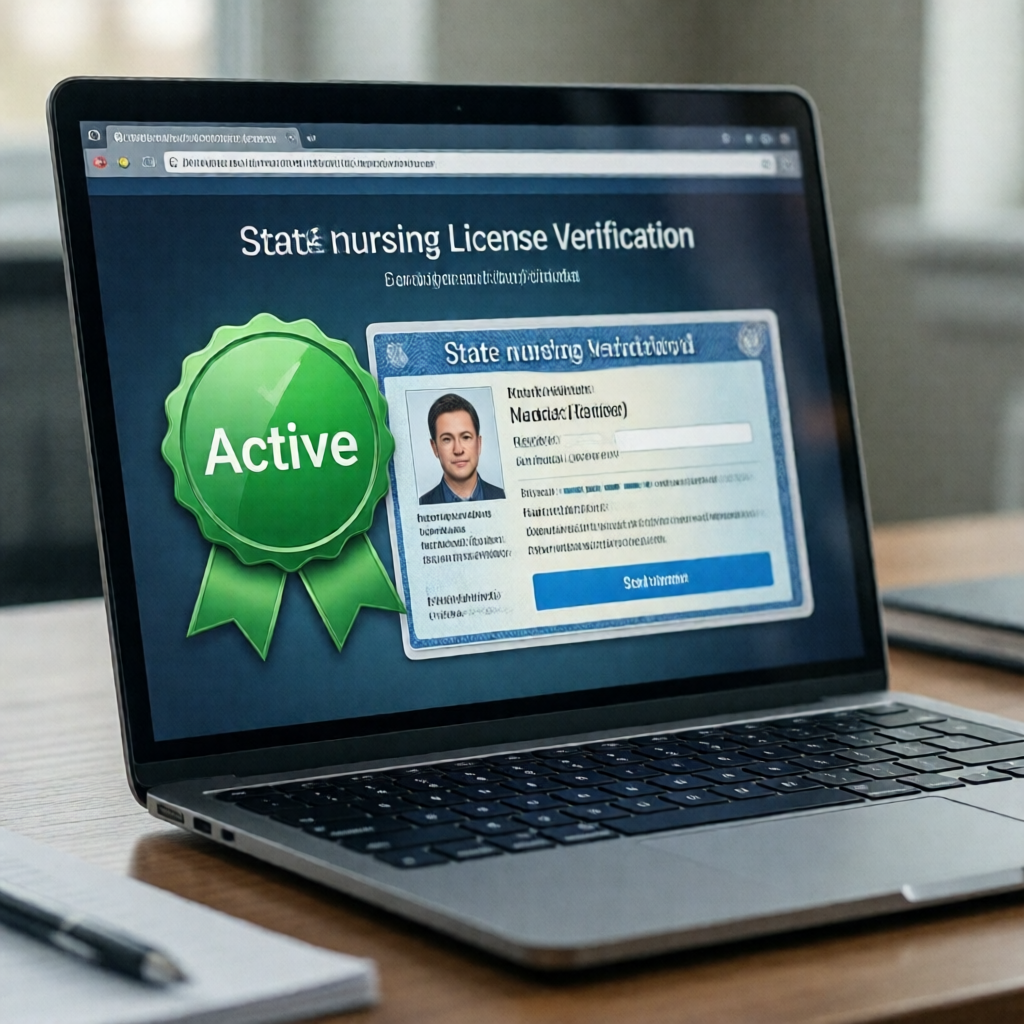
There is no shortcut around step two. Third-party services are useful at volume, but they pull from the same primary sources — they just move faster and bundle the documentation. If you need to understand what these services actually confirm versus what a full background check covers, read our breakdown on credential evaluation vs. credential verification — that distinction trips up most HR generalists the first time they encounter a foreign applicant.
The Best Online Tools for Credential Verification in 2026
You don't need an expensive subscription suite. Three or four free primary-source tools cover 90% of what US-based HR teams encounter.
| Tool | Best For | Cost |
|---|---|---|
| National Student Clearinghouse (NSC) | US academic degrees & enrollment | Free (basic); fee for bulk |
| NURSYS | Nursing licenses (all 50 states) | Free |
| FSMB DocFinder | Physician licenses & board actions | Free |
| State Bar Websites | Attorney admission & disciplinary status | Free |
| CertifyUSA | Business-level trust badges & verification display | See pricing |
Foreign credentials require a separate step: evaluation by a NACES-member agency to confirm equivalency to US standards. Our guide to the best credential evaluation services in the US for 2026 covers the most trusted agencies and realistic turnaround times.
Once your team has verified credentials, the next question is how you signal that externally — to clients, partners, procurement teams. That's where a business verification badge closes the loop between internal HR process and public trust signal.
Once credentials are verified, businesses and service providers can display a CertifyUSA trust badge to communicate that credibility externally — to clients, procurement teams, and partners who weren't in your hiring room.
Online credential verification in 2026 is fast, largely free, and legally defensible — but only if you document it properly. Primary-source databases first. Secondary cross-check second. Every result logged with a name and timestamp. For foreign credentials, add an evaluation step. And if your business needs to demonstrate verified status to the outside world, a trust badge turns your internal process into a public signal that works without explanation.
Frequently Asked Questions
How long does online credential verification take?
Most primary-source lookups — NSC, state licensing boards, NURSYS — return results within minutes to 24 hours. Third-party verification services that bundle multiple checks typically deliver full reports in 1–3 business days, depending on credential type and institution responsiveness.
Can I verify credentials for free?
Yes, for most credentials. State licensing boards, NURSYS, and FSMB offer free public lookups. The NSC provides free basic degree verification for individuals; employers running bulk hiring pay a per-check fee. Third-party services that automate and package the process charge roughly $5–$25 per check — worth it at volume, not required for occasional hires.
What's the difference between credential verification and a background check?
Credential verification confirms a specific degree, license, or certification is real, belongs to this person, and is currently active. A background check is broader — criminal history, employment records, identity confirmation. Run both. See the full breakdown in our credential verification vs. background check guide.
What are the biggest red flags during credential verification?
Credentials from institutions absent from the CHEA or NCES databases — a classic diploma mill signal. License numbers that return no results or surface a different name. Certifications with no independently verifiable issuing body. And any candidate who provides vague details ("I don't remember the license number") warrants a harder look before moving forward.
Do I need consent to verify a candidate's credentials?
Best practice: yes. Include credential verification authorization in your standard hiring paperwork alongside background check consent. Most primary-source databases are publicly accessible, so legal consent isn't always required — but documenting it protects your team and sets clear expectations with candidates from day one.
Ready to show the world your business is verified?
CertifyUSA trust badges turn your internal verification process into a visible credibility signal — for clients, partners, and procurement teams.
Get a Verified Business Trust Badge →Bottom Line: Credential Verification Protects Everyone
Credential fraud is more common than most hiring managers want to admit — and the consequences of missing it range from reputational damage to regulatory liability. A structured verification process doesn't slow hiring down; it catches the 5% of candidates misrepresenting qualifications before they become a costly mistake.
- Start with primary sources — issuing institutions and licensing boards, not just what's on the resume.
- Automate where possible — NPDB, SAM.gov, and CHEA lookups take minutes, not days.
- Document everything — a verified credential file protects your organization in audits and disputes.
- Recheck periodically — licenses expire, certifications lapse, and sanctions get added after hire.
The goal isn't to distrust candidates — it's to confirm what they've told you so you can move forward with confidence. Businesses that verify before they hire build better teams, face fewer liability surprises, and earn the trust of the clients and partners who depend on them.
CertifyUSA Team
Our content is reviewed by business certification and compliance professionals. We cover trust badge implementation, content authenticity verification, and business certification best practices to help businesses build credibility online.
Related Articles
Sustainability Certification Badge for Websites | Verified Green Business Seal
Learn how to display a sustainability certification badge on your website. Show customers you're a verified green business with an eco-friendly trust seal that builds credibility.
Green Business Certification Badge: Display Your Eco Trust Badge (2026)
Learn how to get and display a verified green business certification badge on your website. Show customers your sustainability commitment with a trusted eco trust badge.
Native American Owned Business Badge for Website
Display a Native American owned business badge on your website. Learn how tribal enterprise trust badges complement SBA 8(a) and federal certification programs.
Ready to certify your business?
Join thousands of verified businesses on CertifyUSA.