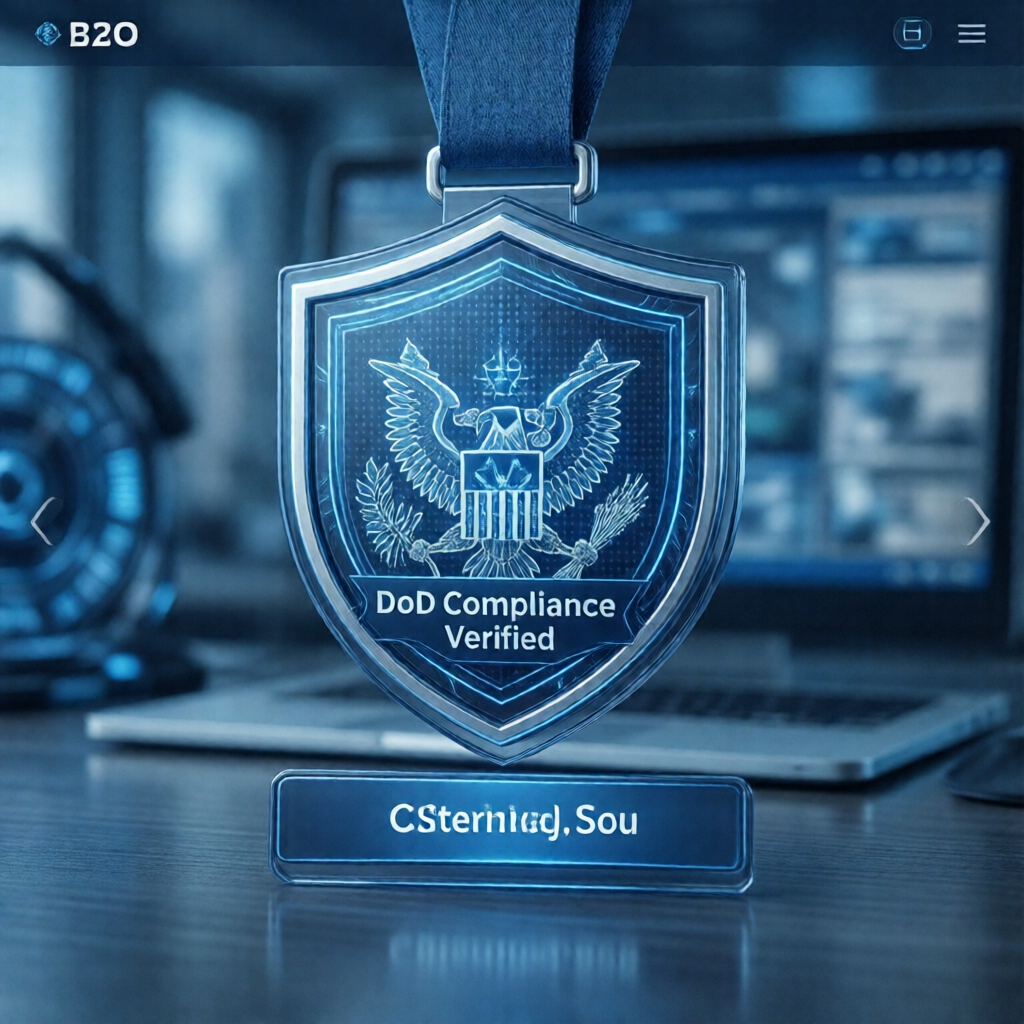
DISA Compliance Badge for Website
Learn what a DISA compliance badge signals to DoD procurement teams and how displaying verified compliance posture on your website wins government contracts.
A contracting officer at a mid-tier DoD systems integrator once told me she screens vendor websites the same way she screens resumes — if the right signals aren't there on the first scroll, the tab closes. For defense contractors, that means one thing: your compliance posture has to be visible before anyone picks up a phone. A DISA compliance badge on your website is exactly that signal.
- DISA (Defense Information Systems Agency) sets cybersecurity standards for DoD systems — distinct from CISA (civilian federal) and FISMA (the federal statute).
- A DISA compliance badge on your site tells procurement teams you understand DoD security requirements before the first RFP conversation.
- CertifyUSA's verified badge is backed by documented compliance posture — not a decorative logo anyone can paste in a footer.
- DISA, CMMC, FedRAMP, and CISA each serve different federal audiences — stack the right ones for your client mix.
What DISA Compliance Actually Covers — and Who Needs It
DISA — the Defense Information Systems Agency — is the DoD's primary IT and cybersecurity authority. It publishes the frameworks contractors must follow to touch DoD networks, systems, or sensitive data.

Three frameworks define DISA compliance. STIGs (Security Technical Implementation Guides) are hardening standards for specific technologies — operating systems, databases, web servers — with hundreds of technical controls per guide. RMF (Risk Management Framework) is the authorization process for DoD information systems, culminating in an ATO (Authority to Operate). DISA APL (Approved Products List) is the vetted catalog of commercial IT products cleared for DoD use.
Sell IT products or services to DoD agencies. Provide cloud hosting to defense clients. Operate as a government systems integrator. Any of those describes you, DISA compliance isn't optional — it's the table stakes.
DISA is not CISA — which covers civilian critical infrastructure under DHS — and it's not FISMA, the statutory framework requiring security controls across all federal agencies. They share philosophical DNA. The application is completely different. If your clients are DoD, DISA is your world.
What a DISA Compliance Badge Communicates to Procurement Teams
Defense procurement is relationship-driven. But every relationship starts with a website screen. Contracting officers and program managers vet dozens of vendors per solicitation. They're not reading your about page. They're scanning for signals.

"Defense procurement teams spend under 90 seconds scanning a vendor's website before deciding whether to request a capability statement."
A verified DISA compliance badge on your homepage signals three things instantly: you understand DoD security requirements, you've documented your posture, and you reduce risk in the procurement decision. That last one matters most. Procurement officers take the path of least friction. Make friction disappear.
A badge doesn't replace a STIG audit — it signals your posture and invites the deeper conversation. The badge opens the door. Your documentation closes the deal.
The distinction that matters: verified badges vs. decorative logos. Any vendor can grab a shield icon from a stock site and paste it in their footer. That's theater. A verified DISA compliance badge — like those issued through CertifyUSA — is backed by a documented compliance posture and business verification process. That's the difference between noise and signal. Your website trust score for vendor audits turns on exactly this distinction.
How to Add a DISA Compliance Badge to Your Website — 4 Steps
Consider a founder running a mid-size government IT firm in Virginia — STIG hardening fully documented, an active RMF engagement underway, solid compliance posture. His website said nothing about it. He was losing first-round screenings to competitors with thinner documentation and better-signaled sites. Four steps changed that.
-
1
Document your DISA compliance posture. Compile your STIG hardening records, RMF ATO status (even in-progress), and any DISA APL-listed products in your stack. If you can't answer "which STIGs apply to our environment," start there. -
2
Complete CertifyUSA's business verification process. This confirms your business entity, operational history, and compliance documentation — a credential procurement teams can reference, not a checkbox they'll ignore. -
3
Select the Federal/DoD compliance badge tier. CertifyUSA offers tiered badges aligned to specific frameworks — choose the one matching your DISA compliance scope: STIG hardening, RMF, or APL-listed product status. -
4
Embed the badge strategically. Homepage hero section, vendor capabilities page, and contact/RFP page. Those are the three pages procurement officers actually visit during initial screening.
DISA vs CISA vs CMMC vs FedRAMP: Which Badge Does Your Site Need?
Most defense contractors need more than one. Start with the framework your primary clients actually care about — then stack from there.
| Framework | Governing Body | Who Needs It | Badge Use Case |
|---|---|---|---|
| DISA STIGs / RMF | DoD / DISA | Defense IT vendors, system integrators | DoD contracts, defense procurement |
| CISA | DHS / CISA | Critical infrastructure, civilian federal | Non-DoD federal, civilian agency bids |
| CMMC | DoD / DIB | Defense contractors handling CUI | DIB supply chain, CUI-scoped contracts |
| FedRAMP | GSA | Cloud service providers | Federal cloud procurement, ATO reuse |
A DoD systems integrator who also handles civilian agency work should display both DISA and CISA compliance signals. CertifyUSA supports all four frameworks from a single verification process.
Verified DISA compliance badges from CertifyUSA give procurement teams an instant trust signal — cutting friction in the vendor vetting stage before you've sent a single email. DoD spends over $50B annually on IT. Your website is your first proposal. Make it legible to the people deciding who gets a call.
Frequently Asked Questions
Is a DISA compliance badge the same as an ATO (Authority to Operate)?
No. An ATO is a formal authorization issued by a DoD Authorizing Official confirming a specific system meets RMF requirements. A DISA compliance badge is a trust signal on your website communicating your compliance posture to procurement teams. It supports the ATO conversation — it doesn't replace it.
Can small defense contractors benefit from displaying a DISA compliance badge?
Especially small vendors competing against larger primes. A verified badge signals that you understand DoD security standards and have documented your posture — it levels the field during initial screening. Larger primes aren't always better-badged. They're just louder.
What's the difference between DISA and CISA compliance for website badges?
DISA (Defense Information Systems Agency) governs cybersecurity standards for the Department of Defense and its contractors. CISA (Cybersecurity and Infrastructure Security Agency) covers civilian federal agencies and critical infrastructure under DHS. DoD clients? Display DISA. Civilian agency clients? Display CISA. Both? Display both.
Do I need DISA compliance if I already have CMMC certification?
CMMC and DISA compliance address different layers. CMMC focuses on protecting Controlled Unclassified Information across the defense industrial base. DISA STIGs and RMF govern the technical hardening and authorization of IT systems themselves. Many DoD vendors need both — and displaying both CMMC and DISA compliance badges gives procurement teams a fuller picture of your security posture.
Ready to Signal Your DISA Compliance Posture?
Get a verified DISA compliance badge for your website — backed by documentation, trusted by DoD procurement teams.
Get Your DISA Compliance Badge →✔ The Bottom Line
DISA compliance isn't just a checkbox — it's a credibility signal that separates serious DoD contractors from the noise. If your business handles defense IT systems, cloud infrastructure, or any DoD-adjacent work, displaying a verified DISA compliance badge on your website tells procurement officers exactly what they need to know before they ever pick up the phone.
- Map your controls to DISA STIGs and RMF before claiming compliance
- Use your badge alongside CMMC or CISA badges when applicable
- Keep documentation current — procurement audits are real
- Place the badge where contracting officers look first: homepage header and About/Compliance pages
Frequently Asked Questions
How long does it take to get DISA compliant?
Timeline depends on your current security posture. Organizations with existing NIST 800-53 or CMMC controls in place can typically complete a DISA RMF assessment in 60–120 days. Starting from scratch — no documented policies, no prior ATO experience — plan for 6–12 months. Engaging a registered DISA assessor early compresses the timeline significantly.
Can small businesses realistically achieve DISA compliance?
Yes, and many do. DISA compliance is role-scoped — you're only assessed on the systems and data types relevant to your contract. A 10-person IT services firm supporting a single DoD component has a far narrower compliance surface than a large prime. The documentation burden is real, but achievable with the right framework guidance and an experienced compliance partner.
Does displaying a DISA compliance badge create legal liability?
Only if the badge is fraudulent. A verified badge backed by documented controls, completed assessments, and an active ATO (or equivalent authorization) is a legitimate business credential. Displaying a badge without supporting documentation — or misrepresenting your authorization status to a federal agency — can trigger False Claims Act exposure. Always ensure your badge reflects your actual documented posture.
What's the difference between a DISA ATO and full DISA compliance?
An Authority to Operate (ATO) is a formal DoD authorization for a specific system to operate at an acceptable risk level. Full DISA compliance is broader — it encompasses all applicable STIGs, RMF controls, and continuous monitoring requirements across your environment. An ATO is the outcome of going through DISA's compliance process, not a shortcut around it.
CertifyUSA Team
Our content is reviewed by business certification and compliance professionals. We cover trust badge implementation, content authenticity verification, and business certification best practices to help businesses build credibility online.
Related Articles
CISA Compliance Badge for Website | Display Verified Cybersecurity Compliance
Learn what a CISA compliance badge signals to partners and clients, which US businesses need one, and how to display verified cybersecurity compliance on your website.
CMMC Compliance Badge for Website | DoD Contractor Trust Signal
Learn how to display a CMMC compliance badge on your website, what CMMC levels mean for defense contractors, and why vendors require visible proof of certification.
FERPA Compliance Badge for Website | Schools & EdTech Trust Signal
Learn how to display a FERPA compliance badge on your website to build trust with parents, students, and school administrators. Step-by-step guide for K-12, higher ed, and EdTech.
Ready to certify your business?
Join thousands of verified businesses on CertifyUSA.