Credential Verification vs Background Check for Hiring 2026
Should U.S. employers run credential verification or a background check first in 2026? Learn the key differences, legal risks, and the right order for hiring.
Hiring a nurse, an attorney, or a licensed engineer in 2026? Here's the hard truth most HR teams discover after a costly mistake: a clean background check says nothing about whether that degree is legitimate. Credential verification vs background check for hiring in 2026 aren't two names for the same process — they answer different questions, carry different legal obligations, and protect against different categories of fraud. Confusing them is one of the most expensive hiring errors a U.S. employer can make. Here's how to get it right.
- Credential verification confirms qualifications are real and current — background checks confirm identity and history.
- For licensed roles, run credential verification first to screen unqualified candidates before spending on a full background check.
- FCRA requires written consent for background checks on final candidates — credential verification carries no such obligation.
- Both processes can run simultaneously for general roles where speed matters more than cost efficiency.
What's the Actual Difference? (And Why It Matters for Hiring)
Credential verification answers one question: Is this person actually qualified? It confirms that degrees, licenses, and certifications were genuinely issued by the stated institution — and that they're currently valid, not expired or quietly revoked. A background check answers something else entirely: Is this person safe to hire? Criminal history. Employment history. Credit, where applicable. Identity confirmation.

These are complementary tools — not interchangeable ones. Skipping either leaves a real gap in your hiring defense.
| Factor | Credential Verification | Background Check |
|---|---|---|
| What it covers | Degrees, licenses, certifications, professional credentials | Criminal history, employment history, credit, identity |
| Core question answered | Is this person qualified? | Is this person safe to hire? |
| Typical turnaround | 1–5 business days | 1–3 business days |
| Cost range | $15–$75+ per credential | $30–$100+ per candidate |
| FCRA compliance required? | Generally no | Yes — written consent + adverse action notices |
Which Should U.S. Employers Run First in 2026?
For regulated roles — healthcare, education, law, engineering, licensed finance — run credential verification first. Full stop. It filters out unqualified candidates before you spend money on a background check. That's not just cost efficiency. It's risk management running in the right sequence.
For general office or operational roles, running both simultaneously is perfectly reasonable when speed is the priority. But for any licensed profession, order matters. Get it wrong and you're either paying for full background checks on candidates who don't meet the basic qualification threshold, or triggering FCRA obligations before you've confirmed the person is even hirable.
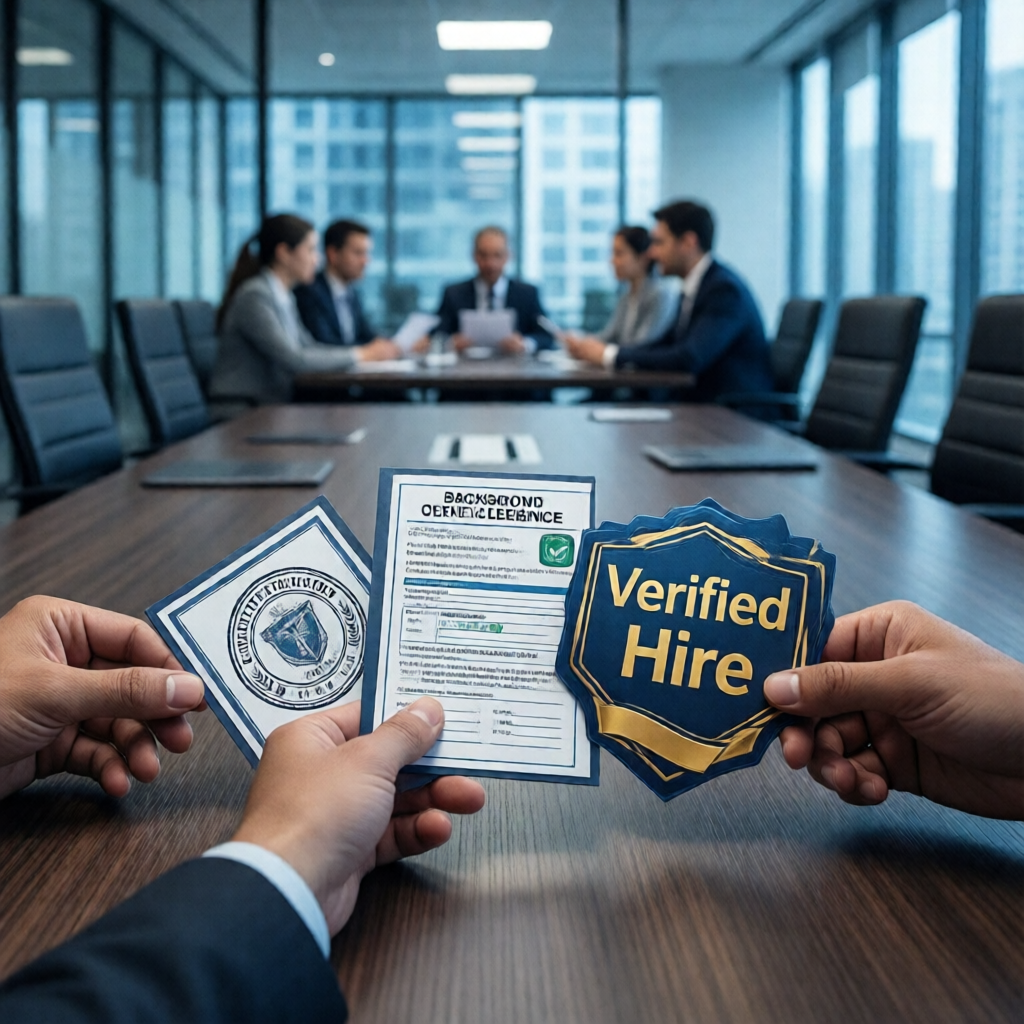
"Under FCRA, a background check on a final candidate demands written consent and adverse action notices. Credential verification doesn't. That asymmetry alone is reason enough to sequence these processes deliberately — not interchangeably."
FCRA compliance governs background checks — not credential verification. And in 2026, California, New York, and Illinois all have active ban-the-box laws that restrict when in the hiring process a criminal background check can run. Credential verification is unaffected by these restrictions. Knowing the difference keeps your process both legally sound and cost-efficient.
Red Flags, Legal Risks & the Cost of Skipping Either
Skip credential verification and you're exposed to negligent hiring liability, regulatory fines in licensed industries, and reputational damage. Healthcare is the clearest example: URAC documented a significant rise in credential fraud investigations through 2024–2025, with fake nursing licenses and fabricated medical degrees among the most common fraud types. A background check catches none of it.
Skip background checks and you're looking at OSHA exposure, workplace safety liability, and potential negligent retention claims if something goes wrong post-hire. Both gaps are real. Both are closeable. Neither excuses the other.
Run credential verification for all licensed roles, then an FCRA-compliant background check after the conditional offer — documented, sequenced, defensible.
Relying on a resume and running only a background check — leaves qualification fraud completely undetected and licensing board requirements unmet.
The U.S. healthcare sector saw a notable rise in credential fraud investigations through 2024–2025, according to URAC. Fake nursing licenses and fabricated medical degrees ranked among the most common fraud types flagged. A background check catches none of this — only a credential verification does.
Know the difference between checking someone's history and verifying their qualifications. These are two separate liability buckets. Both need to be closed. For employers hiring foreign-educated candidates, also understand credential verification vs. credential evaluation — it's a distinct process with distinct requirements.
For regulated industries, credential verification is legally required before hire — a background check alone does not satisfy licensing board requirements. Run both. Sequence them correctly. Document everything.
How to Verify Credentials Before Your Next Hire

Three actions you can take today:
- Use primary-source verification — contact the issuing institution directly or use a recognized credentialing platform. The guide to verifying professional credentials online walks through this step-by-step.
- Check professional license databases — many are free: NPPES for healthcare providers, your state bar for attorneys, and state licensing board lookups for contractors and engineers.
- Issue a verified credential certificate once your hire clears both processes. It creates an internal compliance record and signals rigor to auditors and clients. CertifyUSA's business verification tools can generate and manage these at scale.
Ready to issue verified credential certificates for your team?
Generate a Verified Credential Certificate → CertifyUSA.orgFrequently Asked Questions
Is credential verification the same as a background check?
No — they answer completely different questions. Credential verification confirms that a candidate's degrees, licenses, and certifications are genuine and currently valid. A background check examines criminal history, employment history, identity, and sometimes credit. You need both. Neither replaces the other.
Do U.S. employers legally need to verify credentials before hiring?
In regulated industries — healthcare, education, law, finance, engineering — yes. Licensing boards require proof that professionals hold valid credentials, and hiring without verification exposes employers to negligent hiring liability and regulatory penalties. For general roles the legal obligation varies, but best practice still recommends verification. Accepting falsified credential documents is illegal regardless of role.
Can I run credential verification and a background check at the same time?
For non-licensed roles, yes — running both simultaneously saves time. For licensed or regulated positions, run credential verification first. It screens out unqualified candidates early, so you're not paying for background checks on people who don't meet the basic qualification threshold. Once credentials are confirmed, trigger the background check at the conditional offer stage to stay FCRA-compliant.
Get the sequencing right and you close two liability gaps at once — qualification fraud and safety risk — without doubling your compliance workload.
How long does credential verification take?
Most credential verifications complete within 1–5 business days. Domestic degrees and professional licenses typically return results fastest. International credentials, lapsed licenses, or institutions that require manual outreach can take 7–10 business days. Using an accredited verification service with direct issuer relationships — rather than self-reported documents — delivers the fastest, most defensible results.
What happens if a candidate's credential turns out to be fake?
Withdraw the offer immediately and document everything. Never proceed with employment once fraud is confirmed. Depending on the role and jurisdiction, credential fraud may be reportable to the relevant licensing board or law enforcement. Update your applicant tracking system to flag the candidate. For existing employees discovered post-hire, consult employment counsel before taking action — termination procedures vary by state and union status.
Bottom Line
Credential fraud is not rare — it's routine. Roughly one in three candidates misrepresent qualifications in some form. In regulated industries, hiring an unverified professional isn't just a business risk; it's a legal liability that can cost your organization millions in penalties, lawsuits, and reputational damage.
Verify credentials before you extend a conditional offer. Confirm licenses are active, not just held. Run background checks after qualifications are confirmed. Close both gaps and you've built a compliant, defensible hiring process from day one.
Need professional pay stubs for your verified employees?
Generate accurate, employer-ready pay stubs in minutes — with all required earnings, deductions, and YTD totals included.
Create Your Pay Stub Now → PaystubPRO.comCertifyUSA Team
Our content is reviewed by business certification and compliance professionals. We cover trust badge implementation, content authenticity verification, and business certification best practices to help businesses build credibility online.
Related Articles
Certificate of Achievement Maker – Create & Share Online (Free)
Use a certificate of achievement maker to design, customize, and share professional certificates online in minutes. No design skills needed.
Sustainable Business Certification Badge: Signal Your Green Commitment
Learn how to get and display a sustainable business certification badge on your website to build trust with eco-conscious customers in 2026.
Disability-Owned Business Badge: Get Your DEI Trust Signal
Display a verified disability-owned business badge on your website. Show customers you're certified, build DEI credibility, and stand out from competitors.
Ready to certify your business?
Join thousands of verified businesses on CertifyUSA.